
Mango, Acacia, Sheesham or Teak? Choosing Solid Wood for Furniture
A practical guide for importers, retailers and project buyers comparing mango, acacia, sheesham and teak on looks, hardness, stability, finishes, outdoor use, sourcing, price tier and care, plus how to specify solid wood clearly in an RFQ.
Choosing the timber for a furniture range is one of the earliest decisions a buyer makes, and one of the hardest to reverse. The species you pick shapes the look of the collection, how it performs in a customer's home or a hotel corridor, how it ships, how it is priced and how many complaints land on your desk a year later.
For buyers sourcing solid-wood furniture from India, four species come up again and again: mango, acacia, sheesham and teak. Each has a loyal following, and each has situations where it is the wrong choice. This guide sets out the practical differences between them so you can match wood to product, market and price point with confidence, and then write a specification that a manufacturer can quote against accurately.
It draws on general industry knowledge and on what we see every day at our workshop in Jodhpur, where we work with all four woods. Where figures are given, treat them as approximate guides rather than guarantees: wood is a natural material, and individual boards vary.
The four woods at a glance
Before getting into detail, here is the short version.
- Mango is the value-led, versatile choice: soft-to-medium hardness, lively grain, very accepting of stains and painted or whitewashed finishes. Best indoors.
- Acacia is the hard-wearing, characterful choice: dense, with strong colour variation and bold grain. Popular for dining tables, kitchenware and rustic or modern-organic ranges. Mostly indoor, with some outdoor potential when properly finished and maintained.
- Sheesham (Indian rosewood, Dalbergia sissoo) is the rich, heavy, premium-feeling choice: dense, with dramatic dark streaks and a warm colour. Excellent for statement pieces, cabinets and heirloom-style furniture. Indoors.
- Teak is the performance choice for moisture and the outdoors: naturally oily, highly stable and resistant to decay. It sits at the top of the price ladder.
The rest of this article explains why.
Appearance and grain
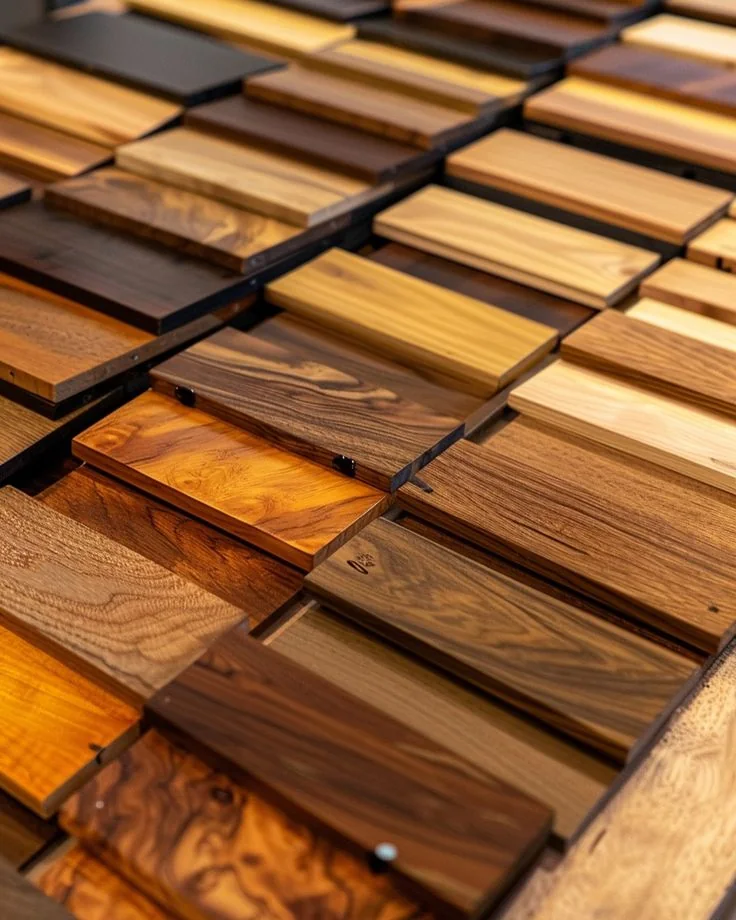
The look of the wood matters even under a heavy finish, because grain shows through stains and texture shows through paint. Buyers who expect a perfectly uniform surface from any of these species will be disappointed; buyers who embrace variation will find each one has a distinctive personality.
Mango
Mango heartwood ranges from pale cream to light golden-brown, sometimes with grey, pink or darker streaks. A characteristic feature is spalting: dark lines and patches caused by natural fungal activity in the tree, which many buyers prize for its marbled effect. Grain is usually medium-textured and can be interlocked, giving a subtle shimmer when finished.
Because the base colour is light, mango is a blank canvas. It looks fresh in natural and whitewash finishes and takes darker stains well.
Acacia
Acacia is the most variable of the four. "Acacia" is a trade name covering several species, and colour can run from honey and golden tones to rich chocolate brown within a single table top. Expect contrasting light sapwood and dark heartwood, wavy or interlocked grain, and visible knots in rustic grades.
That variation is precisely the appeal for many ranges: an acacia dining table rarely looks mass-produced. It does mean buyers should agree acceptable colour variation with their supplier in advance, ideally using reference samples.
Sheesham
Sheesham has a warm golden-brown to deep reddish-brown heartwood with darker, almost black streaks running through it. The grain is often interlocked and the figure can be striking. Paler sapwood is common at board edges, and it is usually either cut away or blended with stain depending on the grade and the design.
Sheesham polishes to a lustrous surface, which is why it is associated with traditional Indian furniture, though it suits clean contemporary designs equally well.
Teak
Teak heartwood is golden to medium brown when freshly cut, darkening with exposure to light. Its grain is generally straight, its texture slightly coarse and its surface has a characteristic oily feel. Left outdoors untreated, teak weathers to a soft silver-grey, a look many outdoor furniture buyers actively want.
Plantation teak, which is what most furniture uses today, can show more colour variation and more sapwood than the old-growth teak of the past.
Hardness and durability
Hardness affects how well a surface resists dents, scratches and everyday wear. The most widely quoted measure is the Janka hardness test, which records the force needed to press a steel ball halfway into the wood. Published figures vary between sources and between samples, so the numbers below are approximate and should be read as a ranking rather than a specification.
| Wood | Approximate Janka hardness | Practical feel |
|---|---|---|
| Mango | roughly 1,000–1,100 lbf | Medium; comparable to many temperate hardwoods |
| Teak | roughly 1,000–1,150 lbf | Medium; durability comes from oils, not hardness |
| Sheesham | roughly 1,600–1,700 lbf | Hard and dense |
| Acacia | varies widely by species; often 1,100–2,000+ lbf | Medium-hard to very hard |
A few points are worth drawing out.
Hardness is not the same as durability. Teak is only moderately hard, yet it is one of the most durable furniture timbers in the world because of its natural oils and resistance to rot and insects. Durability in the trade sense refers to resistance to decay; hardness refers to resistance to denting.
Acacia is hard to generalise. Because "acacia" covers several species from different regions, its hardness ranges widely. Most acacia used in furniture is noticeably harder than mango, which is why it is favoured for dining table tops and kitchenware that take daily knocks.
Sheesham is heavy. Its density makes it feel substantial and resist dents well, but it also adds weight, which affects freight and handling. That matters when you are planning container loads and per-piece shipping costs.
Mango is soft enough to mark. It is perfectly serviceable for most furniture, but a busy family dining table in natural mango will pick up dents over time. A distressed finish turns that into a feature rather than a fault.
Stability and movement
All solid wood moves. It absorbs and releases moisture as humidity changes, swelling and shrinking mainly across the grain. Poorly seasoned timber can crack, warp or open at joints once it reaches a drier climate, which is the single most common cause of solid-wood furniture complaints in export markets.
How the four compare
- Teak is the most stable of the four. Its oils slow moisture exchange, and it moves relatively little, which is a large part of why it performs so well outdoors and on boats.
- Sheesham is generally regarded as stable once properly seasoned, though its interlocked grain needs careful machining.
- Acacia is reasonably stable when kiln-dried, but wide panels and table tops still need design allowances for movement. Its interlocked grain can make it prone to checking if dried too quickly.
- Mango moves more than the others if not seasoned correctly, and it is susceptible to fungal staining and insect attack in the green state. Properly seasoned and kiln-dried mango is perfectly stable for indoor furniture; badly dried mango is a liability.
Why seasoning matters more than species
In practice, how the wood has been prepared matters at least as much as which wood it is. Timber destined for centrally heated homes in Europe or North America should be dried to a moisture content that matches those conditions before it is machined. At Pearl Art Exports, wood is seasoned in-house and then kiln-dried to 8–10% moisture content before production begins, which is a common target range for indoor furniture bound for drier climates.
Good design also helps: table tops fixed with buttons or slotted brackets rather than rigid screws, panels that float in their frames, and allowances for seasonal movement in drawers and doors.
How each wood takes finishes
Finish can transform a species, and it is often where a range's personality comes from. Here is how the four woods behave under the finishes most commonly requested in the trade: natural, walnut, distressed, whitewash and black.
Natural
A natural finish (clear lacquer, oil or wax) shows the wood exactly as it is.
- Mango looks light and fresh, with spalting visible.
- Acacia shows its full colour contrast, which suits rustic and modern-organic ranges.
- Sheesham looks warm and rich, with dark streaks prominent.
- Teak shows its golden tone and will darken over time indoors.
Walnut
Walnut-tone stains darken and even out colour.
- Mango takes walnut stain very well and is often used to achieve a darker, more traditional look at a lower price tier than naturally dark woods.
- Acacia takes walnut well, and the stain helps calm strong colour variation.
- Sheesham is already dark; a walnut finish deepens it and blends sapwood.
- Teak can be stained, but its oils can affect stain absorption, so surface preparation is important. Many buyers prefer teak natural.
Distressed
Distressing (deliberate wear, softened edges, layered or rubbed-back colour) is popular for farmhouse, vintage and industrial ranges.
- Mango is ideal: it is easy to work, and a distressed finish disguises the minor dents its relative softness will pick up in use.
- Acacia distresses well, especially in rustic grades with knots.
- Sheesham can be distressed, though its density makes it harder work and many buyers prefer to show off its figure instead.
- Teak is rarely distressed; reclaimed teak gets its character naturally.
Whitewash
Whitewash and limed finishes lighten wood while letting grain show through.
- Mango is excellent under whitewash because its base colour is already pale.
- Acacia can be whitewashed, but its darker heartwood tends to show through unevenly unless that is part of the intended look.
- Sheesham is generally too dark for a convincing whitewash without heavy pigment.
- Teak is uncommon in whitewash; its oils can interfere with water-based finishes.
Black
Black stains and paints suit contemporary and industrial designs.
- Mango and acacia both take black well, with grain texture showing through stained finishes.
- Sheesham can be finished black for a dramatic look, though it hides much of its natural figure.
- Teak is rarely finished black; buyers choose teak for its natural character.
Custom colours
Beyond these standard options, most experienced manufacturers can colour-match to a supplied swatch, Pantone reference or physical sample. Colour matching on solid wood always involves some tolerance because the base timber varies, so approve a physical finish sample on the actual species before production.
Indoor versus outdoor use
This is where the four woods diverge most sharply.
Teak: the outdoor benchmark
Teak's natural oils and resistance to moisture, decay and insects make it the reference wood for garden, terrace, poolside and hospitality outdoor furniture. It can be left untreated to weather to silver-grey, or oiled periodically to keep its colour. Higher-grade teak with more heartwood performs best outdoors.
Acacia: outdoor with care
Some acacia species have reasonable natural durability, and acacia is widely used for outdoor furniture in moderate climates. It needs a suitable exterior finish or regular oiling, and benefits from covering or storing during harsh winters. It will not match teak's longevity in constant exposure.
Sheesham: indoor
Sheesham has some natural durability, but it is primarily an indoor furniture wood. Covered verandas and conservatories are possible in mild conditions; full outdoor exposure is not recommended.
Mango: indoor only
Mango has low natural resistance to decay and insects and should be treated as an indoor wood. It is well suited to living rooms, bedrooms, dining rooms, hotel guest rooms and retail interiors, but not to gardens or exposed terraces.
For hospitality projects
Hotel and project buyers should think about the specific environment rather than just "indoor" or "outdoor". Bathrooms, spa areas, beach-front restaurants and air-conditioned lobbies all present different humidity and wear conditions. Specify accordingly, and ask for finish systems tested for the setting.
Typical uses by product type
Most buyers work across several product categories. The following guide reflects common practice rather than hard rules.
Dining tables
- Acacia is a favourite for dining tops thanks to its hardness and characterful grain.
- Sheesham suits premium dining tables and is visually impressive in large slabs.
- Mango is popular for value-led dining ranges, especially with distressed or darker finishes.
- Teak is used for both indoor dining and outdoor dining sets.
Side tables and coffee tables
All four work well. Mango is the most common choice for price-sensitive occasional tables; sheesham and acacia suit statement pieces; teak suits outdoor and indoor-outdoor collections.
Consoles and sideboards
Mango and sheesham dominate here. Mango's light base takes whitewash, painted and walnut finishes; sheesham brings richness for premium sideboards and media units. Acacia works well in modern-organic designs.
Cabinets, wardrobes and storage
Sheesham's stability and density suit cabinetry with doors and drawers. Mango is widely used for storage at accessible price points. For large carcasses, buyers sometimes combine solid-wood frames, fronts and tops with other materials for less visible parts, which should always be stated clearly in the specification.
Bowls, boards and kitchenware
Acacia is the leading choice for serving bowls, chopping and serving boards, and utensils: it is hard, has relatively tight grain and looks attractive under food-safe oil. Mango is also widely used for bowls, trays and decorative kitchenware. Sheesham appears in decorative pieces. For anything in contact with food, specify a food-safe finish and confirm that it meets the requirements of your destination market.
Pet furniture
Pet beds, feeding stations and cat furniture need to withstand claws, scratching and cleaning. Acacia and sheesham's hardness helps; mango with a distressed or robust lacquer finish is a sensible value option. Avoid finishes that may flake and ask your supplier to confirm finish safety for the intended use.
Sustainability and sourcing
Buyers and their customers increasingly ask where timber comes from. The broad picture for each species is outlined below. Stated carefully: practices vary by region and supplier, so always ask for the sourcing information relevant to your own orders and market requirements.
Mango
Mango wood generally comes from orchard trees that have passed their productive fruiting years and are felled to make way for new planting. Using that timber for furniture gives value to wood that might otherwise be burned or discarded, which is why mango is often described as a sustainable choice. Supply is plentiful in India.
Acacia
Much furniture acacia is grown in plantations, and many acacia species grow quickly, so it is generally regarded as a renewable resource. Origin varies: some acacia is grown in India, some in South-East Asia and elsewhere.
Sheesham
Sheesham is native to the Indian subcontinent and is widely planted, including along roadsides, canals and on farmland. It is subject to regulation in some contexts, so buyers should confirm documentation requirements for their destination market with their supplier and their own compliance advisers before ordering.
Teak
Teak's sustainability depends heavily on where it comes from. Natural old-growth teak forests have been heavily exploited historically, and trade in timber from some origins is restricted. Most teak furniture today uses plantation-grown teak from a range of tropical countries. Plantation teak is generally the more responsible choice, though it is typically younger, with more sapwood and colour variation than old-growth stock.
Questions to ask
- Which species and origin is the timber?
- Is it plantation, orchard or other source?
- What documentation can be supplied for the timber?
- Are there import regulations in the destination market that require specific due-diligence information?
Your own compliance team should confirm which documents your market requires.
Relative price tiers
Without quoting numbers, which shift with markets, grades and order size, the four woods generally rank as follows from most accessible to most premium:
- Mango — the most accessible price tier, thanks to plentiful supply and easy working.
- Acacia — generally a step above mango.
- Sheesham — mid-to-upper tier, reflecting its density, figure and premium feel.
- Teak — the most premium tier, especially in higher grades suitable for outdoor use.
Remember that the wood is only part of the cost. Design complexity, joinery, hardware, finishing labour, packaging and freight often matter as much as species. A simple mango table and a complex mango cabinet are very different propositions. Heavier woods like sheesham also cost more to ship per piece, which you can model using our container calculator.
Care and maintenance
Good care advice reduces returns and complaints. Consider passing a version of this guidance to your end customers on swing tags or product pages.
General care for all four woods
- Keep furniture away from direct heat sources such as radiators, fireplaces and underfloor heating vents.
- Avoid prolonged direct sunlight, which changes the colour of all woods over time.
- Use coasters, mats and trivets to protect from heat and moisture rings.
- Wipe spills promptly with a soft, slightly damp cloth, then dry.
- Dust with a soft, dry cloth; avoid silicone sprays and harsh chemical cleaners.
- Expect slight seasonal movement in solid wood, and keep indoor humidity reasonably stable where possible.
Species-specific notes
- Mango: treat as a softer surface. Lift rather than drag objects across it. Re-wax or re-oil natural finishes occasionally if specified.
- Acacia: kitchenware should be hand-washed, dried promptly and re-oiled periodically with a food-safe oil. Never leave it soaking or put it in a dishwasher.
- Sheesham: benefits from occasional polishing with a suitable furniture wax to maintain lustre.
- Teak: outdoors, either allow it to silver naturally or clean and oil it seasonally to keep its golden tone. Indoors, it needs very little attention.
How to specify wood in an RFQ
A clear request for quotation saves weeks of back-and-forth and prevents costly misunderstandings at inspection. Whether you are buying from our collections or briefing a new design, include the following.
1. Species and origin
Name the species explicitly (for example, "solid mango" rather than just "hardwood"). If any parts may be made from another material, such as backs, drawer bottoms or internal frames, state which parts and what material is acceptable.
2. Moisture content
State the target moisture content and the tolerance, for example "kiln-dried to 8–10% MC". Ask how moisture is measured and whether readings will be recorded during quality control. Match the target to the climate where the furniture will be used.
3. Grade and character
Define what is acceptable:
- Knots: allowed, limited (size and number), or not allowed on visible surfaces.
- Sapwood: allowed, allowed only if stained to match, or not allowed.
- Colour variation: natural variation accepted, or matched within a piece.
- Natural features: spalting, mineral streaks, small checks or filled cracks.
Reference photos or a physical sample of the grade are worth far more than words.
4. Finish
Specify the finish name (natural, walnut, distressed, whitewash, black or a custom colour), the sheen level (matt, satin, gloss), the finish type (lacquer, oil, wax, paint) and any market requirements for finish composition. Supply a physical colour reference for custom colours and approve a finish panel on the actual species.
5. Dimensions and tolerances
Provide overall dimensions and key internal dimensions, together with tolerances, for example ±3 mm on overall dimensions and tighter tolerances on parts that must fit with other components. Remember that solid wood moves, so overly tight tolerances on wide panels may be unrealistic.
6. Construction and hardware
Specify joinery where it matters (mortise and tenon, dovetail drawers, knock-down fittings), hardware type and finish, and whether pieces ship assembled or flat-packed.
7. Packaging, testing and labelling
Detail carton specifications, drop-test or other testing requirements, assembly instructions, labelling and barcodes, and any market-specific marking.
8. Quantities and shipping
State sample quantity, first-order quantity and whether you are planning a mixed container (LCL) or a full container (FCL). Our trade & export page explains how sample orders, LCL and FCL shipments work with us.
9. Quality control and approval
Agree in advance how quality will be checked and what you will receive. At Pearl Art Exports, samples are made for approval before production, and every order goes through three-stage quality control with pre-shipment inspection reports and photographs. Whatever supplier you use, make sure the approved sample becomes the reference standard for production.
A sample RFQ wood specification
| Item | Example specification |
|---|---|
| Species | Solid acacia, all visible parts |
| Moisture content | Kiln-dried, 8–10% MC, readings recorded at QC |
| Grade | Small sound knots allowed; no open cracks; natural colour variation accepted |
| Finish | Walnut stain, satin lacquer, matched to approved sample |
| Tolerance | ±3 mm overall dimensions |
| Construction | Mortise-and-tenon frame, top fixed with movement allowance |
| Approval | Pre-production sample approval; pre-shipment inspection photos |
If you are developing your own designs, our custom manufacturing page explains how we work from sketches, photos or full tech packs through OEM and ODM production.
Quick comparison table
| Mango | Acacia | Sheesham | Teak | |
|---|---|---|---|---|
| Colour | Pale cream to light brown, often spalted | Honey to dark brown, high variation | Golden to reddish-brown, dark streaks | Golden to medium brown, silvers outdoors |
| Grain | Medium, sometimes interlocked | Wavy or interlocked, bold | Interlocked, striking figure | Generally straight, oily feel |
| Hardness | Medium | Medium-hard to very hard | Hard | Medium |
| Stability | Good when properly dried | Good when kiln-dried | Good | Excellent |
| Outdoor use | No | Limited, with finish and care | Not recommended | Yes, the benchmark |
| Best finishes | All, especially whitewash, distressed, walnut | Natural, walnut, black, distressed | Natural, walnut | Natural or weathered |
| Typical uses | Consoles, storage, side tables, value dining | Dining tops, kitchenware, rustic ranges | Premium dining, cabinets, statement pieces | Outdoor sets, hospitality, premium indoor |
| Sourcing | Orchard trees past fruiting | Largely plantation | Native and widely planted | Plantation preferred |
| Relative price | Most accessible | Accessible to mid | Mid to upper | Most premium |
Frequently asked questions
Which wood is the best overall?
There is no single best wood, only the best wood for a given product, setting and price point. Mango offers value and finishing flexibility, acacia offers toughness and character, sheesham offers richness and density, and teak offers outdoor performance.
Can I mix woods within one collection?
Yes, and many buyers do: for example, an acacia dining table with mango sideboards in a matching walnut finish. Expect slight differences in how each species takes the same stain, and approve finish samples on each wood.
Is mango wood strong enough for furniture?
Yes. Properly seasoned and kiln-dried mango is a sound, widely used furniture timber for indoor use. It is softer than acacia or sheesham, so finishes that tolerate wear, such as distressed, are a smart choice for heavily used pieces.
Will solid wood crack in a centrally heated home?
Any solid wood can move or crack if it was not dried properly or if it is exposed to extreme heat or very dry air. Correct kiln-drying, good design allowances for movement and sensible care advice minimise the risk significantly.
Why does my sample look different from the catalogue photo?
Natural timber varies in colour and grain from tree to tree and board to board. Screens and printing also alter colour. Agree acceptable variation in advance and use the approved physical sample as the production reference.
Can you match my own colour?
Custom colour matching is available on all four woods. Supply a physical reference where possible, and approve a finished sample on the actual species.
Making the choice
Choosing between mango, acacia, sheesham and teak comes down to four questions: where will the furniture live, how hard will it be used, what look does your market want and what price tier are you targeting. Answer those, write a clear specification, and approve physical samples before production, and you will avoid the majority of problems buyers face with solid-wood furniture.
If you are planning a new range or reviewing an existing one, we are happy to help you compare these woods side by side. Request a catalogue or ask us for finish and wood samples, and we will send you the materials you need to make a confident decision.